Categories
On the web

AndNav2 is now Open Source

Wow this is quite a nice suprise. Nicolas gave in and released the source of AndNav2. So I can now spend my time hacking that instead of reverse-engineering it 🙂 I rooted my HTC Hero so I actually don’t need to do that anymore, but that is really beside the point. With the source available there is no ends to what can be done 🙂

As I have said before, I really think this is a killer app for Android. Google released their navigation which is nice, but I’m not sure how well it works in offline mode.

Categories
Programming

Programming nirvana part 4: the repl

A repl is a very important tool in the arsenal of a programmer. It allows one to test bits and pieces of code and then assembling that into a running program. Examples of this includes the excellent firebug utility for firefox and various shells (like the python shell). There has even been tries to bring a repl to C#, but the languages is not at all designed for this purpose, so it’s a crude hack at best.

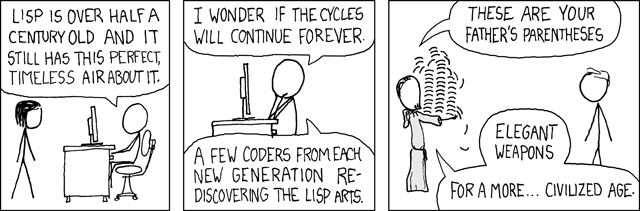
Often developing using the repl consists of a lot of copy pasting back and forth between then editor and the repl. Moving the repl into the editor makes this even less painful, but I would argue that in order to fully embrace a repl one has to have something like lisp, or a very good editor (that I havn’t seen yet). In lisp it’s very easy to take parts of a function and evaluation only that part simply by finding the right parenthesis and evaluation that. Using Emacs and SLIME it’s a simple two-key-gesture.

But one can take it one step further. Why not simply start your program as a repl, instead of adding a repl to your program. That way also the running state of the program can be determined. But in order for that to work, one has to be able to redefine functions without stopping the program. Clojure allows that, and it’s the key that makes it all work.

Programming in clojure is a process of organically growing your program in a bottom-up fashion where the running state of the program allows one to inspect, debug and fix programs all without shutting it down.

The best way to do this is to start up a repl in a seperate process and then to connect to that process, that way one can always disconnect and reconnect again when the need arises.
Categories
Programming

Programming nirvana part 3: avoid relational databases

This is actually a blog post I have been meaning to write for quite a while not, but I just never got around to it. Relational databases are ubiquitous in programming. Whether it’s mainframes, application programming or even phones now a days everyone stores persistent data in a database. Recently there has been some talk about non-schema databases and there’s a myriad different implementations of them, but why the sudden interest?

  • Database has at least two things that makes it less than ideal for agile development. First one being types, especially if the types propagate out into the application code (*cough* Microsoft). The second being based on a schema, which means that one has to make all the choices up front.
  • Databases are really built for a single machine, and even though all the big database vendors has replication support, it still seems like a bad solution if one really wants scalability. There are a lot better ways of doing scalability now a days (a distributed hash tables comes to mind).
  • Databases are meant to be standardized, but in reality they are not. They all have different syntax to do common things.
  • It has been said that when you build a DSL, then sooner or later it will turn into a (bad) full-fledged programming language. What if instead the data was simply part of the program and you could manipulate it as you are used to? Functional languages makes this much easier and possible. Especially a programming language that is built with concurrency in mind.
Categories
Programming

Programming nirvana part 2: be agile

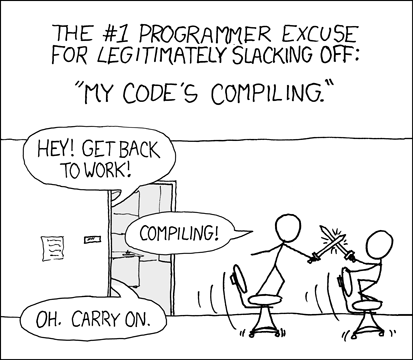
In part 1 I made the very brief argument that compiling sucks. I really like that cartoon since there is a lot of truth to it. Compiling sucks mainly because it breaks flow. There has been several tries to fix it by lowering the time it takes to compile but in the end, it’s still the same loop: write, compile, “debug”.

There is another layer to it as well, one that dynamic languages doesn’t necessarily imply: Developing a program should be having a running program that can be used while it is being written. This is one of the pillars of agile programming. Step one in achieving this goal is to separate the UI from the backend. Web is a natural way to do this.

Django comes very close to achieving this with it’s automatic reloading on change, but the biggest problem is that it’s not able to automatically migrate the most basic model changes. On the other hand Django has many other things going for it so it is by no means a bad choice. But there might be a better one lurking in the dark.

Categories
Programming

Programming nirvana part 1: avoid compilation

I have been meaning to write about a new project I have been working on in my spare time for a while now. It’s a project where I wanted to maximize the fun I had doing it, learn something new and to do something that I can use. Sadly I have been putting it off since enumerating all the reasons feels like quite a daunting task.  So instead of writing everything in one big blog post I’ll just do shorter posts. One for each argument. First one is pretty simple.